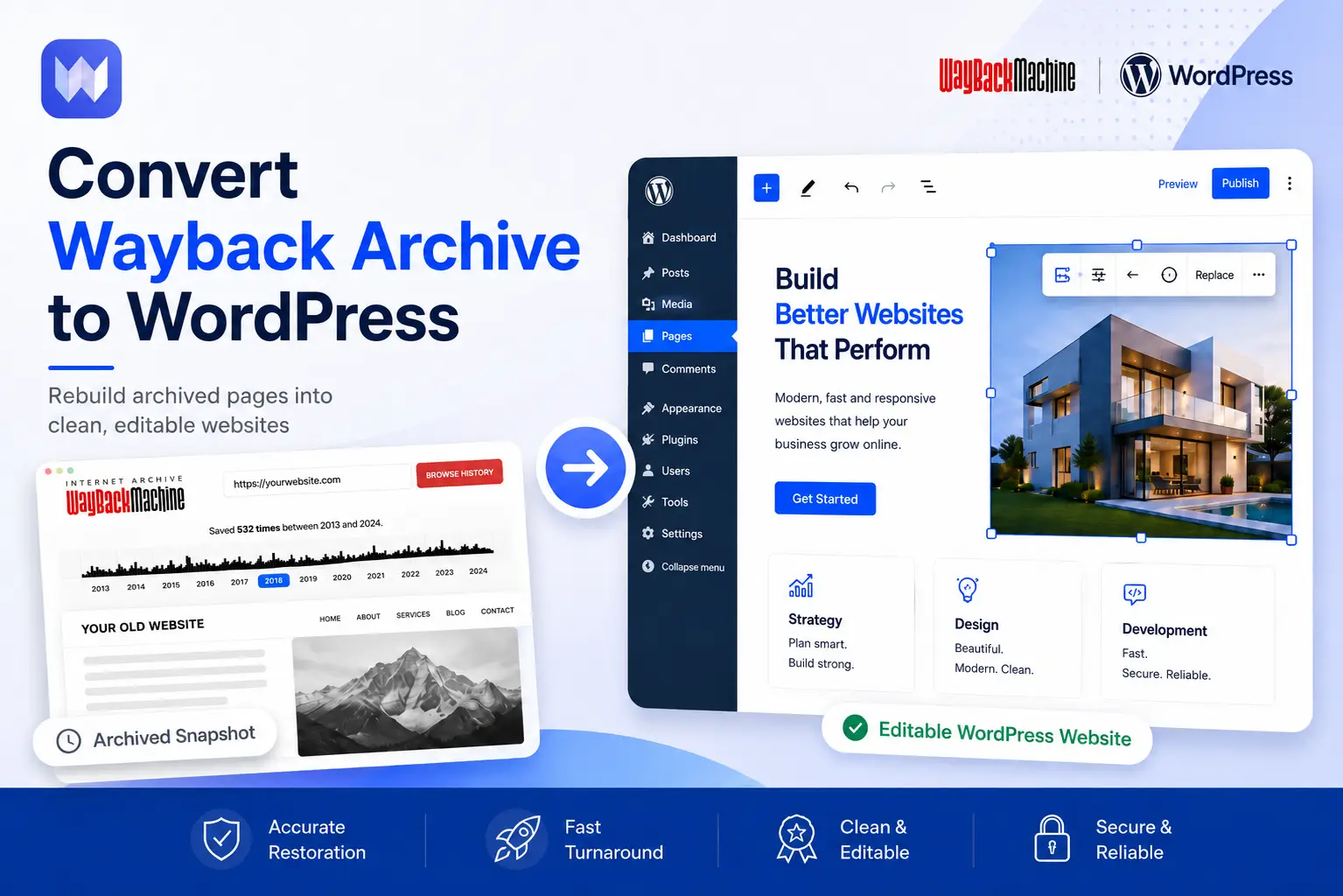
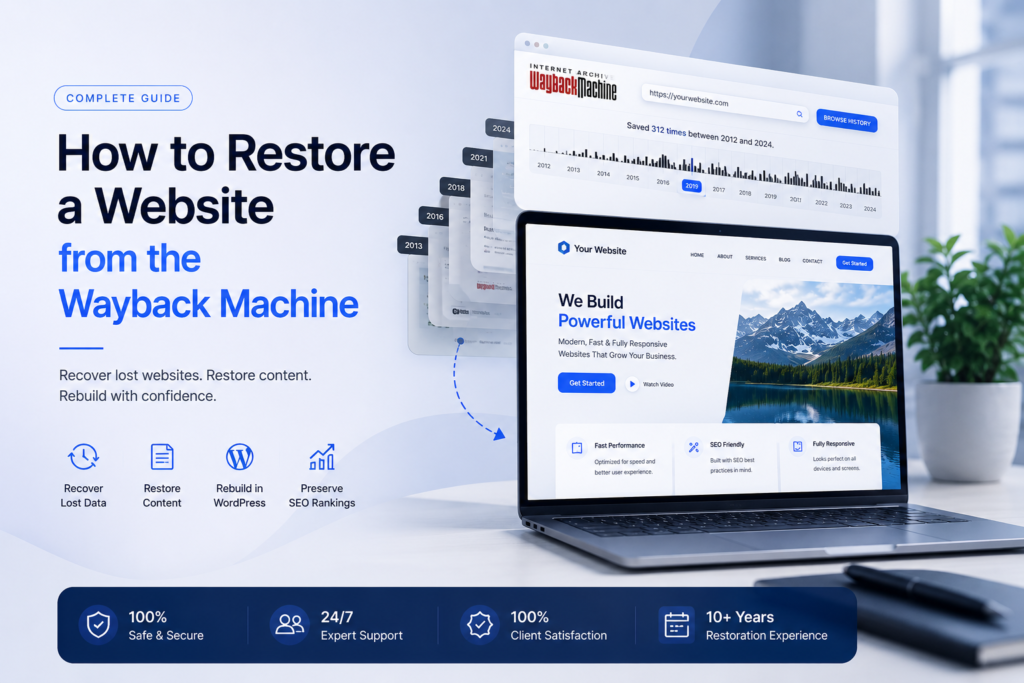
Losing a website can feel overwhelming, especially if there is no backup available. Many business owners assume their website is gone forever after a hosting failure, hacked server, expired domain, or accidental deletion. In reality, a large part of the website can often still be recovered using archived versions stored online.
One of the most valuable resources for website recovery is the Wayback Machine. It stores snapshots of websites from different points in time and can sometimes help recover pages, blog posts, images, and even parts of the original website structure.
However, restoring a website from archived data is not always as simple as downloading a copy and publishing it again. Some archived websites are incomplete, some assets may be missing, and modern rebuilding is usually required to make the website fully functional again.
This guide explains how website restoration from the Wayback Machine works, what can realistically be recovered, the common limitations, and what to expect during the recovery process.
Whether you lost a personal blog, business website, WordPress site, or an old company website, this article will help you understand the recovery process clearly.
What Is the Wayback Machine?
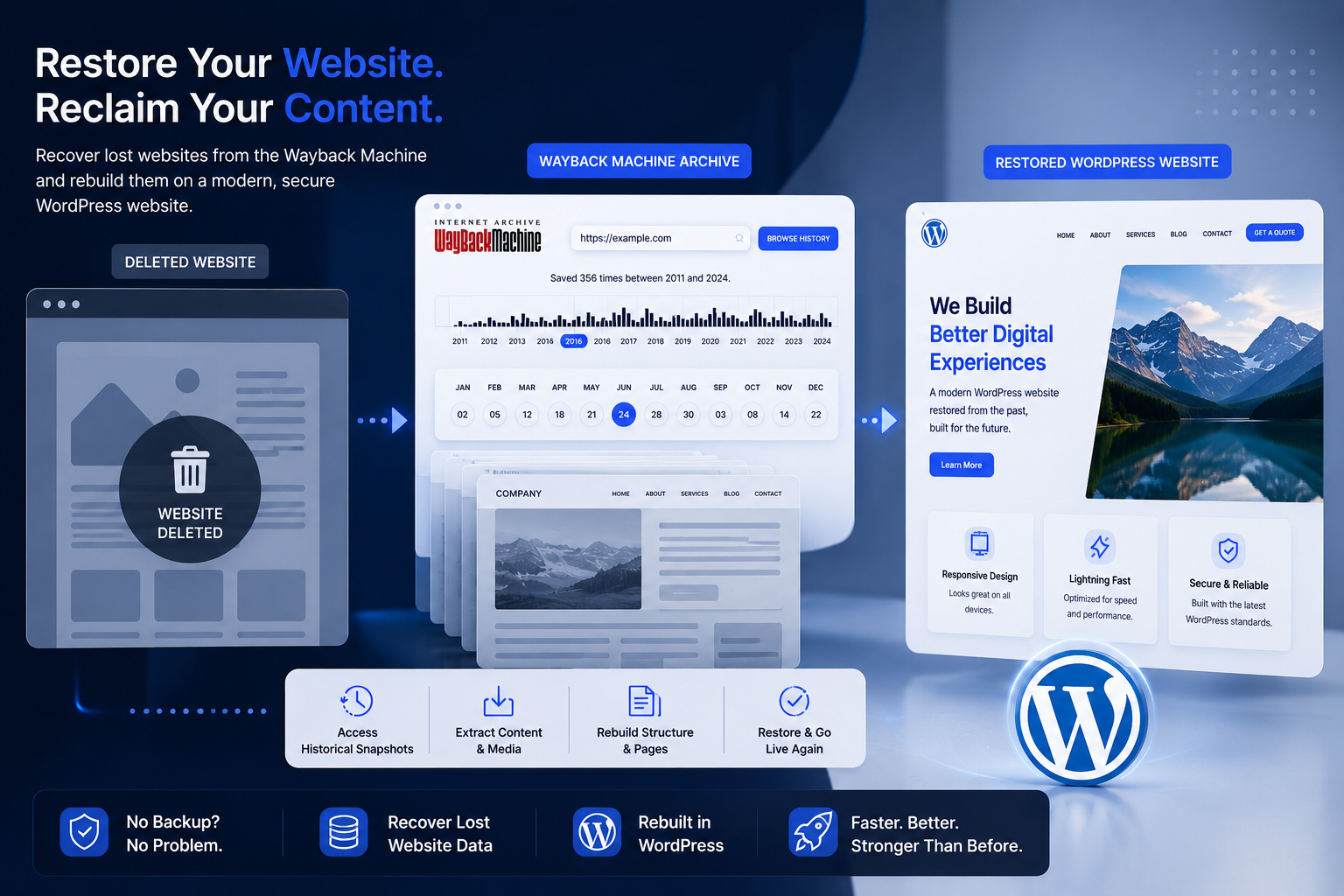
The Wayback Machine is a digital archive created by the Internet Archive organization. It stores historical snapshots of websites from different dates over many years.
You can think of it as a historical library of the internet.
When a website is archived, the system saves copies of:
- web pages,
- images,
- text content,
- navigation structure,
- and some design elements.
These archived versions are called snapshots.
For example, if a website existed in 2020, the Wayback Machine may contain multiple saved versions of that website from different dates throughout the year.
This allows users to:
- view old versions of websites,
- recover lost content,
- research historical changes,
- or rebuild deleted websites.
The Wayback Machine is especially useful when:
- the original hosting is lost,
- backups are unavailable,
- the website was deleted,
- or the original developer no longer has the files.
Many businesses discover that even after losing their website completely, archived snapshots still contain a large amount of recoverable information.
How Does the Wayback Machine Archive Websites?
The archive system uses automated crawlers that scan public websites across the internet. These crawlers collect publicly accessible data and store snapshots at different times.
Depending on the website, the archive may contain:
- a few snapshots,
- dozens of snapshots,
- or even hundreds collected over many years.
Some websites are archived more frequently than others.
Popular or active websites often have better archive coverage, while smaller websites may have fewer saved versions.
It is also important to understand that the Wayback Machine does not always capture everything perfectly.
Some elements may be missing, including:
- videos,
- animations,
- dynamic database content,
- protected pages,
- or externally hosted files.
That is why website restoration usually involves both:
- archive recovery,
- and manual rebuilding work.
Can a Website Really Be Restored from the Wayback Machine?
Yes, in many cases a website can be partially or fully restored using archived data.
The success of the recovery depends on several factors:
- how much of the website was archived,
- how old the website is,
- whether images were captured,
- whether the structure is still accessible,
- and whether dynamic content existed.
Simple websites are usually easier to recover.
For example:
- business websites,
- blogs,
- portfolio websites,
- informational websites,
- and older HTML websites often recover well.
More advanced websites may require additional rebuilding work.
Examples include:
- eCommerce stores,
- membership websites,
- booking systems,
- dashboards,
- and custom web applications.
In these situations, the visible front-end design and content may still be recoverable, but dynamic functions often need to be rebuilt manually.
A common misunderstanding is that archived websites can always be restored perfectly with one click. In reality, professional website restoration usually involves:
- extracting archived content,
- rebuilding layouts,
- recreating pages,
- restoring URLs,
- fixing missing assets,
- and optimizing the website again for modern devices and SEO.
Still, even incomplete archives can provide enough information to rebuild a website successfully.
That is why many deleted websites are recoverable even without backups.
What Can Usually Be Recovered from an Archived Website?
One of the most important questions people ask is:
“What parts of my website can actually be restored?”
The answer depends on the archive quality, but many important elements are often recoverable.
Website Pages
Main pages are usually the easiest part to recover.
This may include:
- homepage,
- about page,
- services,
- blog pages,
- contact pages,
- and landing pages.
If multiple snapshots exist, older versions of missing pages may also be recoverable.
Blog Posts and Written Content
Text content is often preserved very well inside archived snapshots.
This can include:
- articles,
- tutorials,
- product descriptions,
- guides,
- and company information.
For many businesses, recovering the written content alone can save a huge amount of time.
Images and Media Files
Images are sometimes archived successfully, but not always.
Recovery quality depends on:
- how the images were originally hosted,
- whether the image URLs were archived,
- and whether external image systems were used.
In some cases:
- all images can be recovered,
- some images may be missing,
- or replacement images may need to be added manually.
This is very common during website restoration projects.
Website Structure and Navigation
Archived websites often preserve:
- menus,
- navigation structure,
- internal links,
- categories,
- and overall page hierarchy.
This is extremely useful because it helps rebuild the website structure accurately.
Preserving the original structure can also help maintain SEO consistency during restoration.
URLs and SEO Structure
Many archived websites still contain:
- original URLs,
- page titles,
- meta information,
- and internal linking structures.
This can be valuable for businesses that want to preserve existing search engine rankings or rebuild SEO authority after website loss.
Maintaining the same URL structure is often one of the most important parts of professional website restoration.
Downloadable Files and Documents
Sometimes archived websites also preserve:
- PDFs,
- brochures,
- downloadable documents,
- and media files.
However, downloadable files are less consistently archived than standard pages.
These files may require additional manual recovery work.
What Cannot Always Be Recovered?
While website restoration from the Wayback Machine can be very effective, there are still limitations.
Some elements are commonly missing from archived websites, including:
- databases,
- user accounts,
- shopping cart systems,
- dynamic applications,
- custom backend functionality,
- private content,
- and server-side systems.
For example, an eCommerce website may recover:
- product pages,
- images,
- and design structure,
but:
- customer orders,
- inventory systems,
- and payment functionality
usually cannot be recovered directly from the archive.
In these situations, manual rebuilding becomes necessary.
This is why professional website restoration is often a combination of:
- archive recovery,
- structured rebuilding,
- SEO preservation,
- and modern website redevelopment.
At this stage, the most important thing to understand is this:
Even if your website is deleted and no backup exists, recovery may still be possible.
The archived version of your website can often provide enough structure, content, and design references to rebuild a working website again.
Common Reasons Websites Need Restoration
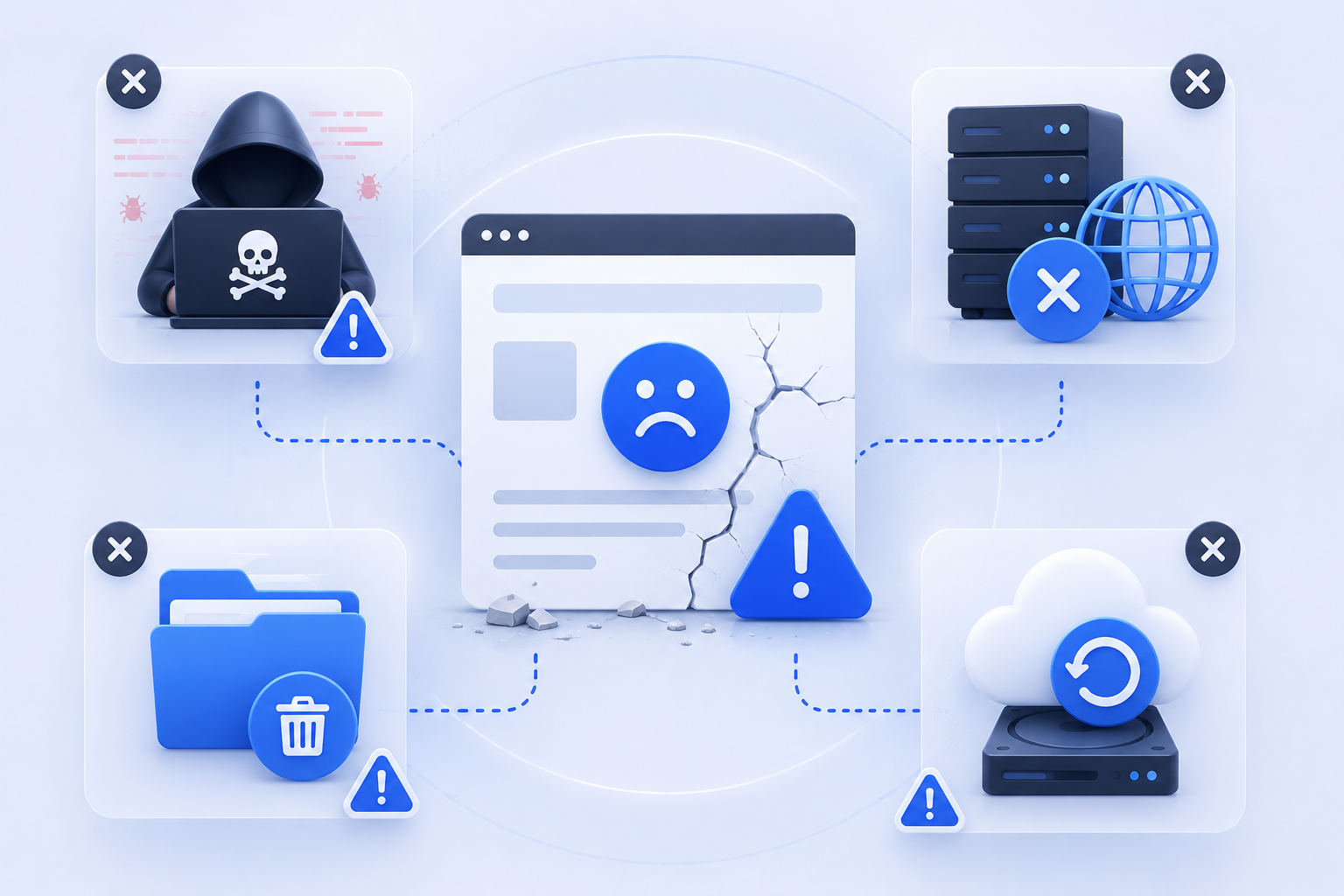
Many people assume websites only disappear because of hacking, but in reality there are several common situations that can lead to complete website loss.
Some websites disappear suddenly, while others slowly break over time because of outdated systems, hosting issues, or failed migrations.
Understanding why websites get lost can help you identify the best recovery approach and avoid the same problem in the future.
Hacked Websites
One of the most common causes of website loss is hacking.
A hacked website may:
- become inaccessible,
- display malware warnings,
- get deleted by attackers,
- or become heavily corrupted.
In some situations, the hosting provider may suspend the website completely for security reasons.
Unfortunately, many hacked websites also have damaged backups or infected files, making normal recovery difficult.
When this happens, archived versions from the Wayback Machine can sometimes become the only reliable source of recovery.
Expired Hosting or Domain Issues
Websites are often lost because hosting accounts expire or domains are not renewed in time.
This is especially common with:
- old business websites,
- abandoned projects,
- small company websites,
- or websites managed by former developers.
Sometimes the hosting company permanently deletes the files after account expiration.
Business owners may only realize the problem after:
- the website disappears,
- emails stop working,
- or customers report the issue.
If backups were never created, archive recovery may become the only option available.
Accidental Website Deletion
Websites can also be lost because of human error.
Examples include:
- deleting files accidentally,
- removing the wrong database,
- overwriting the website during updates,
- or deleting hosting accounts unintentionally.
This often happens during:
- redesign projects,
- migrations,
- server cleanup,
- or developer changes.
Even experienced website owners sometimes lose important data accidentally.
Failed Website Migrations
Website migrations can become risky if they are not handled properly.
Problems during migration may include:
- broken databases,
- corrupted files,
- incomplete transfers,
- missing media,
- or failed server configurations.
In some cases, the original website is removed before the new version works correctly.
This can leave the business without a working website at all.
Archived versions are often extremely valuable in these situations because they still preserve:
- page content,
- layouts,
- and website structure.
No Website Backups
Many small businesses believe backups exist until something goes wrong.
Unfortunately, some websites:
- never had backups,
- used outdated backup systems,
- or stored backups on the same failed server.
This becomes a serious problem after:
- hosting failures,
- malware attacks,
- or accidental deletion.
One of the biggest reasons professional website restoration services exist is because many businesses discover too late that no usable backup actually exists.
Outdated or Abandoned Websites
Older websites sometimes stop functioning because:
- plugins become outdated,
- themes break,
- hosting environments change,
- or old code becomes incompatible.
The website may still exist partially, but:
- layouts break,
- pages stop loading,
- or important functions stop working.
In these cases, rebuilding the website using archived content and a modern platform like WordPress is often the safest long-term solution.
How the Website Restoration Process Actually Works
Many people think website restoration is simply downloading archived files and uploading them again.
In reality, professional website restoration is usually a structured rebuilding process.
The archive acts as the foundation, but the website often needs:
- reconstruction,
- optimization,
- manual fixes,
- and modern redevelopment.
The exact process depends on:
- the archive quality,
- the website type,
- missing assets,
- SEO requirements,
- and whether the website needs redesigning.
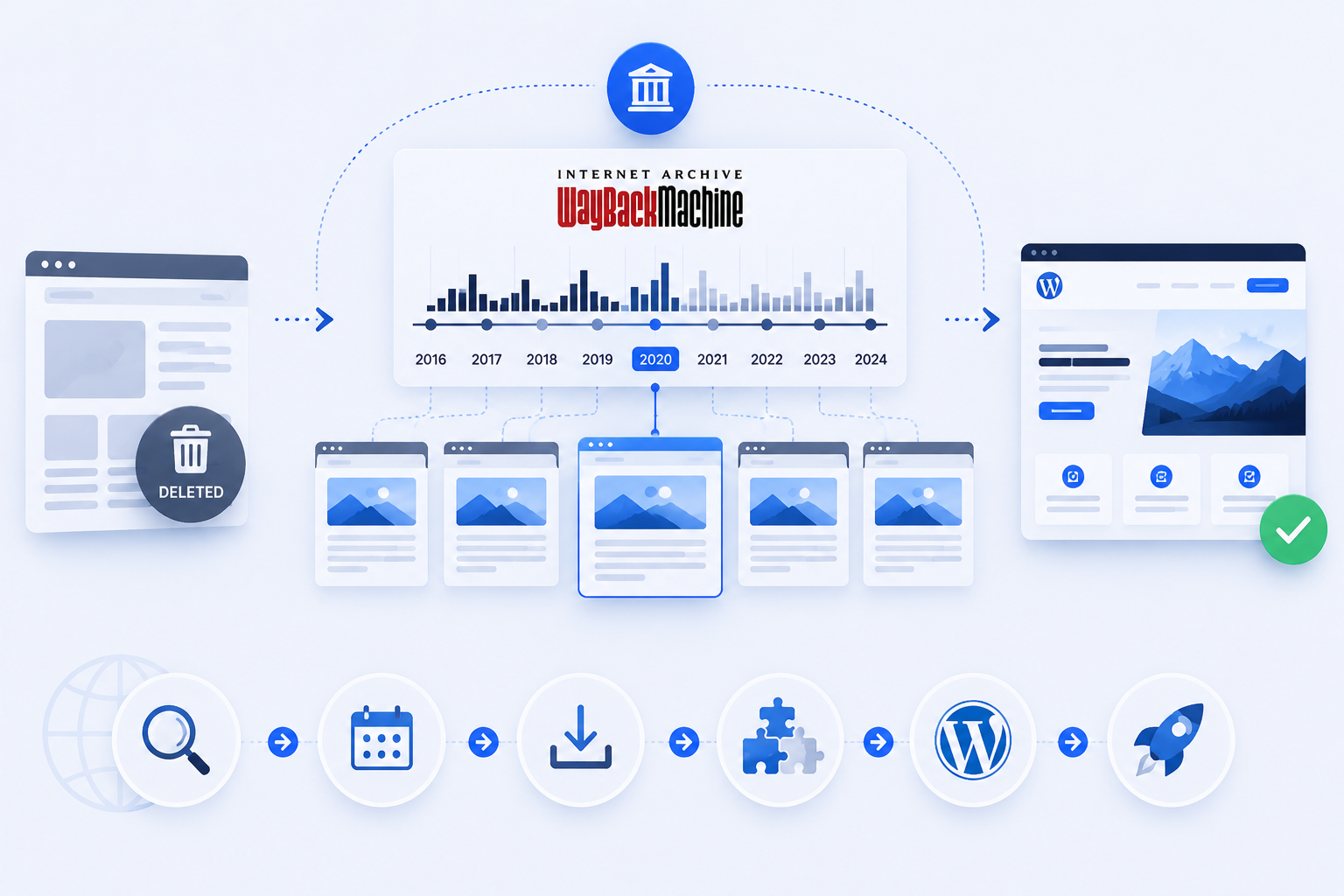
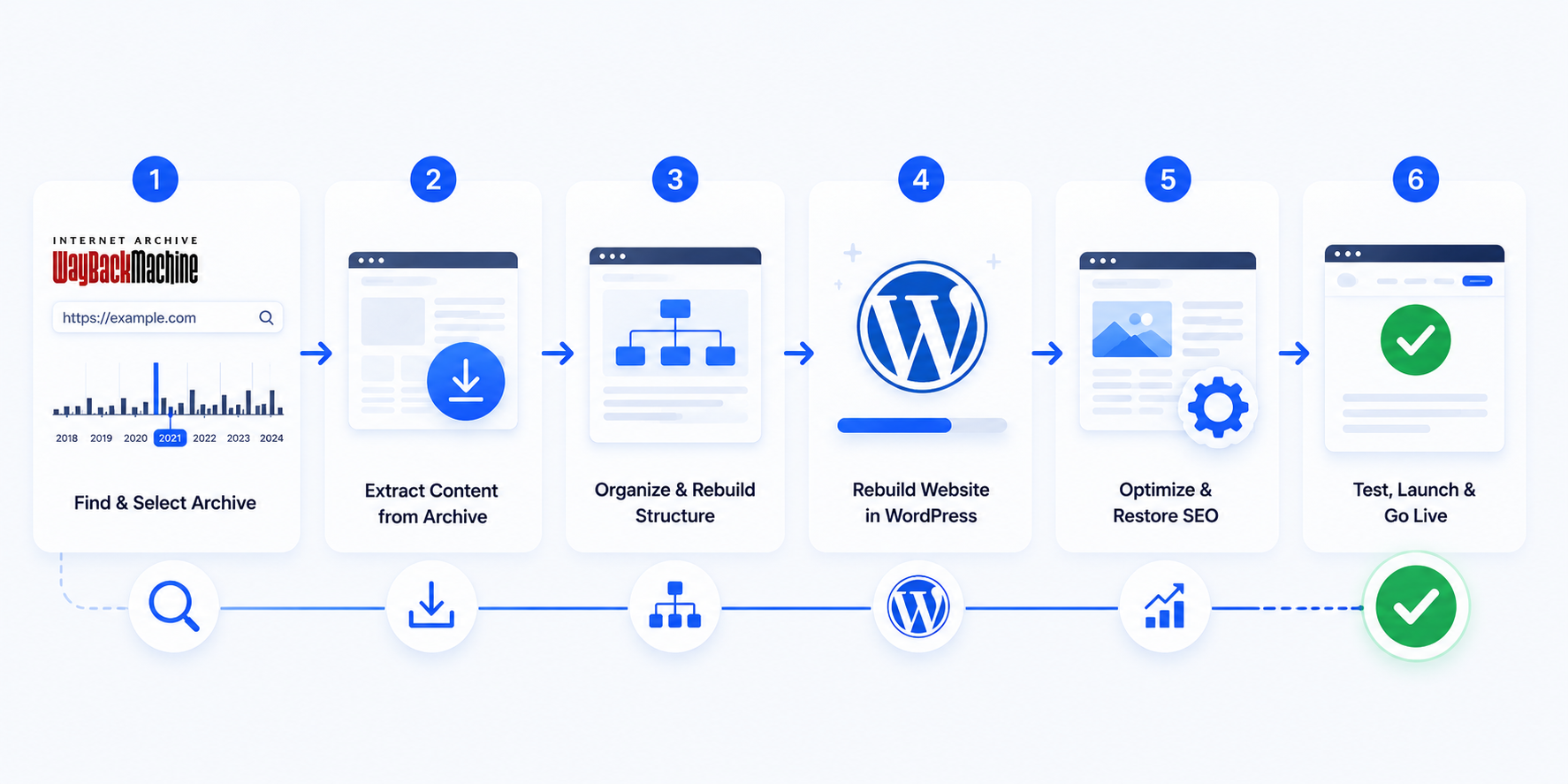
Below is the typical professional website restoration workflow. Our restoration process page explains how the review, rebuild, and quality checks fit together for a managed project.
Step 1: Archive Analysis
The first step is analyzing the archived website carefully.
This includes checking:
- available snapshots,
- page coverage,
- image availability,
- navigation structure,
- and archived dates.
Not all snapshots contain the same information.
Sometimes:
- older snapshots contain better layouts,
- while newer snapshots contain updated content.
Professional restoration usually combines information from multiple archived versions to rebuild the most complete website possible.
This stage is important because it determines:
- what can realistically be recovered,
- what may need rebuilding,
- and what content is missing.
Step 2: Content Extraction
Once the archive is analyzed, the next step is extracting the recoverable content.
This may include:
- text content,
- blog posts,
- page layouts,
- downloadable files,
- images,
- and metadata.
Depending on the project, extraction may be:
- partially automated,
- manually reviewed,
- or fully rebuilt by hand.
This step is especially important for preserving:
- original business information,
- SEO structure,
- and written content.
For websites with large amounts of content, structured extraction tools can help speed up the recovery process.
In some situations, archive downloader tools may help collect recoverable website data more efficiently before rebuilding begins.
Step 3: Rebuilding the Website Structure
After extracting the content, the website structure needs to be rebuilt.
This includes recreating:
- menus,
- navigation,
- categories,
- page hierarchy,
- and internal linking.
Maintaining the original structure is important because:
- users are familiar with it,
- search engines understand it,
- and it helps preserve SEO consistency.
This step is often more complex than people expect because archived websites are not always complete or properly connected.
Broken internal links and missing pages usually need manual correction.
Step 4: Restoring URLs and SEO Structure
One of the most important parts of professional website restoration is preserving SEO structure.
This includes restoring:
- original URLs,
- page titles,
- metadata,
- headings,
- and internal links.
If the URL structure changes unnecessarily, the website may lose:
- rankings,
- indexed pages,
- backlinks,
- and search visibility.
For business websites with existing SEO authority, this step is extremely important.
A properly restored website should maintain as much SEO continuity as possible.
Step 5: Rebuilding in WordPress
Many restored websites are rebuilt in WordPress because it provides:
- flexibility,
- easier management,
- responsive design support,
- and long-term scalability.
Depending on the project, the restoration may involve:
- Elementor rebuilding,
- Divi rebuilding,
- custom theme recreation,
- or complete redesign while preserving content.
This stage usually includes:
- recreating layouts,
- restoring media,
- optimizing mobile responsiveness,
- and modernizing the design if needed.
In many cases, the rebuilt WordPress version becomes much more stable and manageable than the original website.
Step 6: Testing and Optimization
Before the restored website goes live, it should be tested carefully.
This includes checking:
- broken links,
- missing images,
- mobile responsiveness,
- loading speed,
- forms,
- and SEO structure.
Even a successfully rebuilt website can still contain:
- archive-related issues,
- formatting problems,
- or incomplete media.
Testing ensures the final website works properly across:
- desktop devices,
- tablets,
- and mobile phones.
Manual Website Restoration vs Professional Website Restoration
Some small websites can be restored manually with enough time and patience.
However, many archived websites become much more complicated once the recovery process begins.
At first, the website may look recoverable because the homepage appears inside the archive. But deeper problems often appear later, including:
- missing pages,
- broken layouts,
- missing CSS,
- incomplete images,
- or lost navigation structure.
This is where the difference between manual recovery and professional restoration becomes important.
Manual Website Restoration
Manual restoration may work for:
- very small websites,
- personal blogs,
- or simple HTML websites.
A DIY approach may involve:
- copying archived text,
- downloading available images,
- rebuilding pages manually,
- and recreating layouts.
However, this process can become very time-consuming.
Common challenges include:
- inconsistent archive quality,
- missing assets,
- broken formatting,
- and incomplete SEO structure.
Many users underestimate how much rebuilding work is actually required after downloading archived content.
Professional Website Restoration
Professional restoration services focus on rebuilding the website in a structured and reliable way.
This usually includes:
- archive analysis,
- content recovery,
- SEO preservation,
- WordPress rebuilding,
- responsive optimization,
- and manual corrections.
Professional restoration becomes especially important for:
- business websites,
- SEO-sensitive websites,
- eCommerce websites,
- or websites with incomplete archives.
Instead of simply recovering files, the goal is to rebuild a stable, modern, and functional website that can continue operating long-term.
At this point, you can probably see why website restoration is much more than downloading archived snapshots.
A successful restoration usually requires:
- recovery,
- rebuilding,
- optimization,
- SEO preservation,
- and modern website redevelopment working together.
Can You Restore a Website Without a Backup?
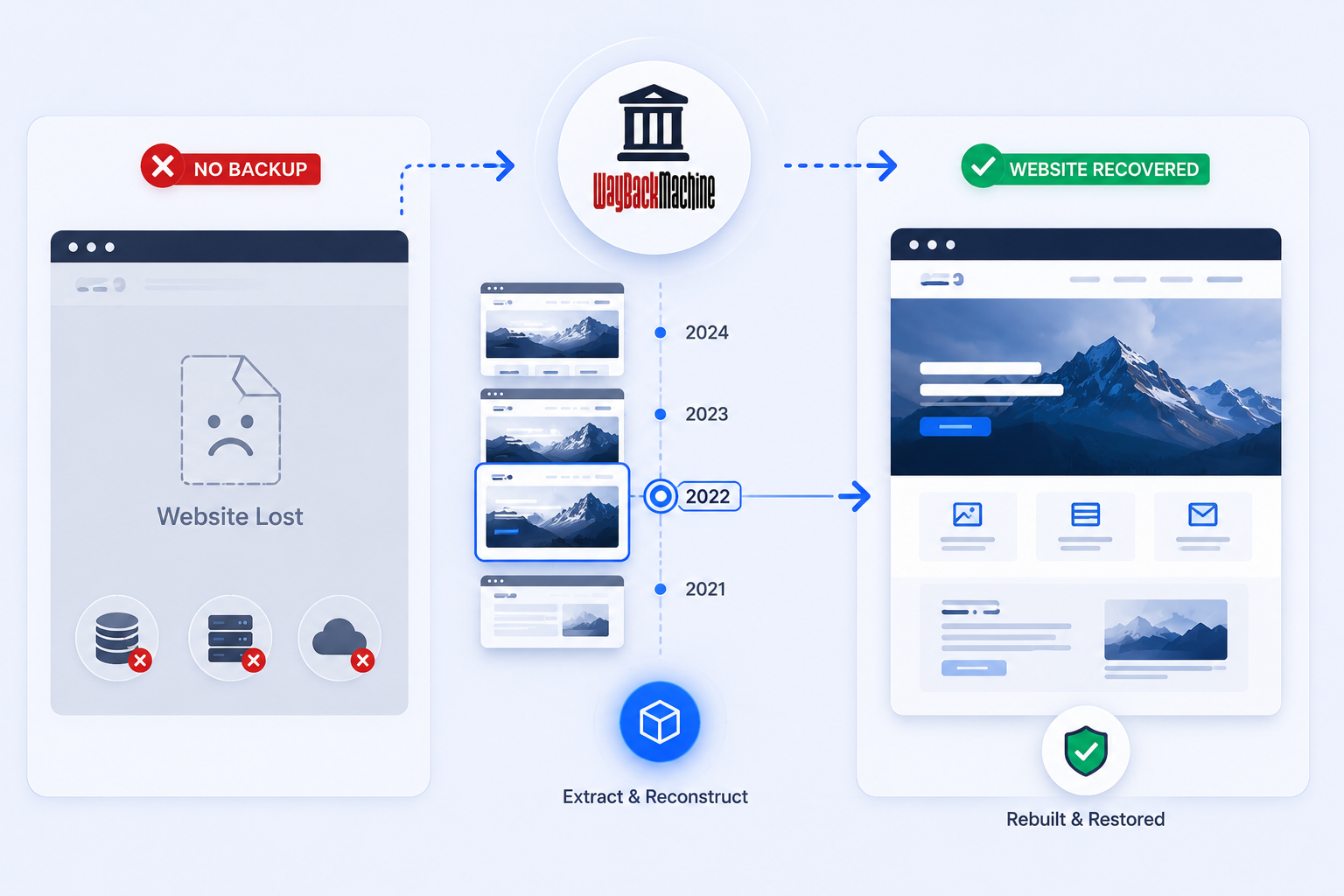
Yes, in many cases a website can still be restored even if no backup exists.
This is one of the most common situations in professional website restoration projects. Many business owners only discover the importance of backups after:
- the hosting account is deleted,
- the website is hacked,
- the server fails,
- or the original developer disappears.
The good news is that archived website data can often provide enough information to rebuild the website successfully.
However, recovery quality depends heavily on:
- the archive coverage,
- the type of website,
- how the website was originally built,
- and whether important assets were archived properly.
When Website Recovery Is Usually Possible
Website recovery without backup is often possible when:
- the website was publicly accessible,
- the Wayback Machine captured multiple snapshots,
- pages were indexed properly,
- and core assets were archived successfully.
This is especially true for:
- business websites,
- blog websites,
- portfolio websites,
- service websites,
- and informational websites.
These types of websites usually rely heavily on front-end content, which archives often preserve relatively well.
For example, archived snapshots may still contain:
- service pages,
- blog posts,
- navigation menus,
- page layouts,
- and written content.
Even if the original hosting account is gone, the archived structure may still provide enough material to rebuild the website professionally.
What Recovery Depends On
Not every archived website contains the same amount of recoverable data.
Some websites may have:
- complete snapshots,
- working images,
- and strong archive coverage.
Others may only contain:
- partial pages,
- incomplete layouts,
- or missing assets.
Several factors influence recovery quality.
Archive Coverage
The more snapshots available, the better the recovery potential usually becomes.
Older websites with years of archived history often provide:
- multiple design versions,
- historical pages,
- and more complete structures.
This gives restoration specialists more reference material during rebuilding.
Website Type
Simple websites are generally easier to restore.
Examples include:
- blogs,
- service websites,
- local business websites,
- and company portfolio websites.
Complex websites can still be rebuilt, but usually require more manual work.
Examples include:
- eCommerce stores,
- membership systems,
- booking platforms,
- and custom applications.
These websites often depend on dynamic databases that archives cannot fully preserve.
Image and Asset Availability
Some websites archive media files very well, while others lose important assets during the crawl process.
This may include:
- missing images,
- missing videos,
- missing fonts,
- or incomplete styling files.
In many restoration projects, some assets need to be:
- manually recreated,
- redesigned,
- or replaced with updated versions.
Original Website Structure
Websites with clean architecture are usually easier to recover.
For example:
- properly linked pages,
- organized navigation,
- and accessible content
often archive more successfully than:
- poorly structured,
- JavaScript-heavy,
- or dynamically loaded websites.
Realistic Limitations of Website Restoration
It is important to understand that website restoration is not always perfect.
Some users expect a complete one-click recovery identical to the original website. In reality, archived recovery often involves rebuilding work.
Certain elements are commonly difficult or impossible to recover directly from archives.
These may include:
- databases,
- user accounts,
- customer orders,
- admin dashboards,
- payment systems,
- private files,
- or dynamic search systems.
For example:
an online store may recover:
- product pages,
- product descriptions,
- and images,
but:
- customer data,
- inventory systems,
- and order history
usually cannot be restored from archived snapshots alone.
That is why professional website restoration often combines:
- archive recovery,
- manual rebuilding,
- WordPress redevelopment,
- and SEO reconstruction.
Common Problems During Website Restoration
Even when a website is recoverable, restoration projects often contain technical challenges that need manual correction.
Some issues are minor, while others require significant rebuilding work.
Understanding these common problems helps set realistic expectations before starting the restoration process.
Missing Images and Media Files
One of the most common restoration problems is missing images.
This happens because:
- some image URLs were never archived,
- external image hosts failed,
- or the archive crawler could not access certain files.
As a result, recovered websites sometimes contain:
- broken image placeholders,
- low-quality archived versions,
- or missing media sections.
In many cases, missing images need to be:
- replaced manually,
- recreated,
- or redesigned.
This is especially common with:
- sliders,
- banners,
- background graphics,
- and product galleries.
Broken CSS and Styling Issues
Archived websites do not always preserve styling files correctly.
This can lead to:
- broken layouts,
- incorrect spacing,
- missing colors,
- or damaged formatting.
Some archived websites appear functional at first glance but contain major styling problems once individual pages are opened.
Modern rebuilding platforms are selected according to the archived site and the editing experience required after launch. A standard WordPress restoration works well for many content-led sites, while Elementor restoration is more suitable when the rebuilt pages need visual drag-and-drop editing.
Incomplete Website Archives
Some websites simply were not archived completely.
This may happen because:
- certain pages were blocked,
- the crawler missed sections,
- or snapshots were captured inconsistently.
As a result, restoration projects sometimes require combining:
- multiple archive dates,
- partial snapshots,
- and manual reconstruction work.
This is why professional restoration usually starts with a detailed archive analysis instead of relying on a single snapshot.
Missing Databases and Dynamic Content
Dynamic websites often depend on databases to function properly.
Examples include:
- eCommerce systems,
- membership websites,
- booking systems,
- and custom dashboards.
Archives may preserve the visible front-end pages, but not the backend systems powering the website.
This means:
- products may need rebuilding,
- forms may require recreation,
- and dynamic functions may need redevelopment manually.
This is one of the biggest differences between:
- static website recovery,
- and full functional website rebuilding.
Broken Layouts and Responsive Issues
Older websites were not always designed for modern devices.
Even if the archived version loads successfully, it may:
- break on mobile devices,
- display incorrectly,
- or contain outdated layouts.
Many restoration projects involve:
- rebuilding responsive layouts,
- improving usability,
- and modernizing the website structure.
This is especially important for:
- SEO,
- user experience,
- and modern search rankings.
Missing Fonts and Design Assets
Custom fonts and design resources are frequently missing from archived websites.
This can affect:
- branding consistency,
- typography,
- and overall design quality.
Professional rebuilding often includes:
- matching fonts,
- recreating branding,
- and rebuilding the design more cleanly using modern tools.
In many cases, the restored version becomes visually better than the original website while still preserving the original content and structure.
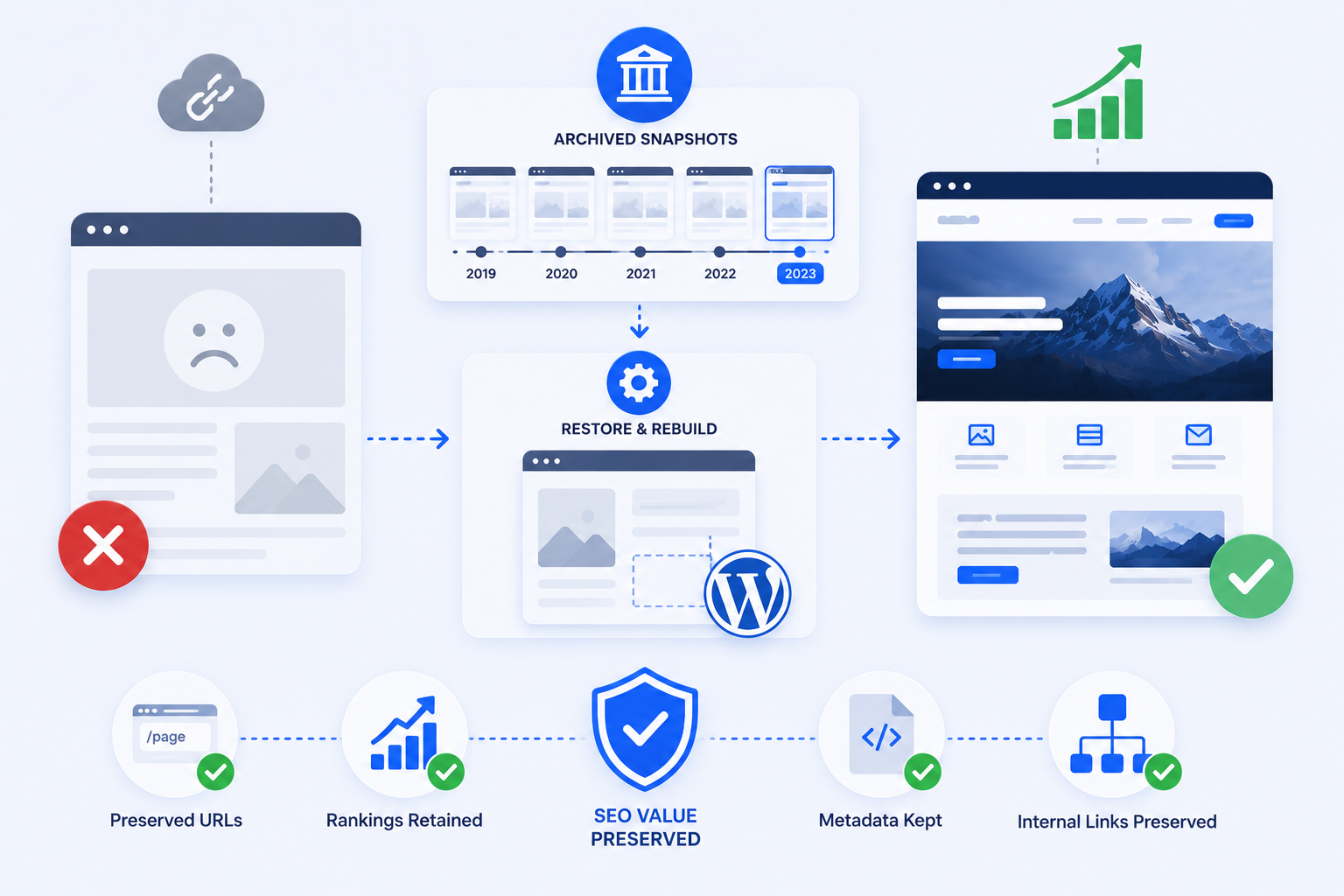
How to Preserve SEO During Website Restoration
For business websites, preserving SEO is often just as important as recovering the design itself.
A poorly handled restoration can damage:
- search rankings,
- indexed pages,
- backlinks,
- and organic traffic.
That is why SEO preservation should be part of the restoration strategy from the beginning.
Preserve the Original URL Structure
One of the most important SEO rules during website restoration is maintaining the original URLs whenever possible.
Search engines already associate those URLs with:
- rankings,
- backlinks,
- authority,
- and indexed content.
Changing URLs unnecessarily can cause:
- ranking drops,
- broken backlinks,
- and traffic loss.
Professional restoration usually involves rebuilding the website using the same page structure and URL hierarchy.
Restore Metadata and Page Titles
Archived websites often still contain:
- SEO titles,
- headings,
- meta descriptions,
- and page structures.
Restoring this information helps preserve:
- keyword relevance,
- indexing signals,
- and page consistency.
Even when redesigning a website, maintaining important metadata can support SEO continuity during recovery.
Fix Broken Internal Links
Archived websites often contain broken links after recovery.
This may happen because:
- pages are missing,
- structures changed,
- or archive references remain inside the content.
Broken internal links can negatively affect:
- crawlability,
- user experience,
- and SEO performance.
A professional restoration process should include:
- link auditing,
- navigation rebuilding,
- and internal structure correction.
Use Proper Redirects When Needed
Sometimes certain pages cannot be restored exactly.
In those situations, proper redirects help preserve SEO value.
For example:
- removed pages,
- renamed URLs,
- or rebuilt content sections
should redirect properly instead of returning errors.
This helps search engines understand the updated structure and reduces ranking disruption.
Optimize the Rebuilt Website for Modern SEO
Many old websites were built using outdated technologies or poor optimization practices.
A rebuilt version provides an opportunity to improve:
- mobile responsiveness,
- performance,
- page speed,
- accessibility,
- and technical SEO.
This is one reason many businesses choose:
- WordPress rebuilding,
- Elementor restoration,
- or modern redesign approaches during restoration.
The goal is not only to recover the website, but also to create a stronger and more maintainable version moving forward.
At this stage, you now understand an important reality about website restoration:
Recovering archived data is only part of the process.
A successful restoration also requires:
- rebuilding,
- optimization,
- SEO preservation,
- and solving technical recovery problems properly.
What Is the Best Way to Restore an Archived Website?
The best restoration method depends on:
- the condition of the archive,
- the type of website,
- the importance of SEO,
- and whether the website needs modernization.
Some small websites can be rebuilt manually with basic recovery work. However, for most business websites, the safest long-term approach is rebuilding the website properly using a modern content management system like WordPress.
A structured rebuild provides much better:
- stability,
- responsiveness,
- SEO management,
- security,
- and long-term maintainability.
Instead of simply recreating an outdated website exactly as it was, many restoration projects focus on:
- preserving the original content,
- maintaining the structure,
- and rebuilding the website using modern standards.
This creates a restored website that is both:
- historically accurate,
- and technically improved.
Why WordPress Is Commonly Used for Website Restoration
WordPress is one of the most popular platforms for rebuilding archived websites because it offers flexibility and easier long-term management.
A restored WordPress website can be:
- easier to update,
- easier to optimize,
- more mobile-friendly,
- and better prepared for future growth.
This is especially useful for:
- business websites,
- blogs,
- service websites,
- and content-heavy websites.
WordPress also makes it easier to:
- preserve SEO structure,
- manage redirects,
- optimize performance,
- and rebuild layouts more efficiently.
For many businesses, moving an archived website into WordPress becomes a practical long-term upgrade instead of just a recovery project.
Elementor and Modern Website Rebuilding
Many modern restoration projects use Elementor to rebuild archived websites.
Elementor allows developers to:
- recreate layouts visually,
- improve responsiveness,
- modernize outdated designs,
- and rebuild pages more efficiently.
This is especially useful when:
- the original website design is incomplete,
- old styling files are broken,
- or the archived version needs modernization.
In some restoration projects, the goal is:
- rebuilding the exact same design.
In other cases, the goal is:
- preserving the content and structure,
- while redesigning the website with a cleaner modern appearance.
Both approaches are common depending on the project requirements.
Why Responsive Rebuilding Matters
Many archived websites were originally built years ago before modern mobile optimization standards became important.
Even if the archived version still loads, it may:
- break on mobile devices,
- display incorrectly,
- or provide poor usability.
Responsive rebuilding helps ensure the restored website works properly across:
- desktops,
- tablets,
- and smartphones.
This is important not only for users, but also for:
- modern SEO,
- Google rankings,
- and overall website performance.
A professionally restored website should feel modern and usable, not simply copied from an outdated archive.
Preserving Structure and Content During Rebuilding
One of the biggest mistakes during website restoration is rebuilding the website without preserving its original structure.
This can damage:
- SEO,
- user familiarity,
- and search engine indexing.
A good restoration process usually preserves:
- important URLs,
- navigation hierarchy,
- page organization,
- and core content structure.
This creates better continuity between:
- the original website,
- and the rebuilt version.
For businesses with existing search visibility or backlinks, this is extremely important.
Tools That Can Help During Website Recovery
Website restoration often combines:
- archive analysis,
- extraction tools,
- manual rebuilding,
- and SEO optimization.
Some tools can help simplify parts of the process.
However, it is important to understand that tools alone usually cannot fully restore a professional website automatically. Most successful restoration projects still require manual rebuilding and optimization work.
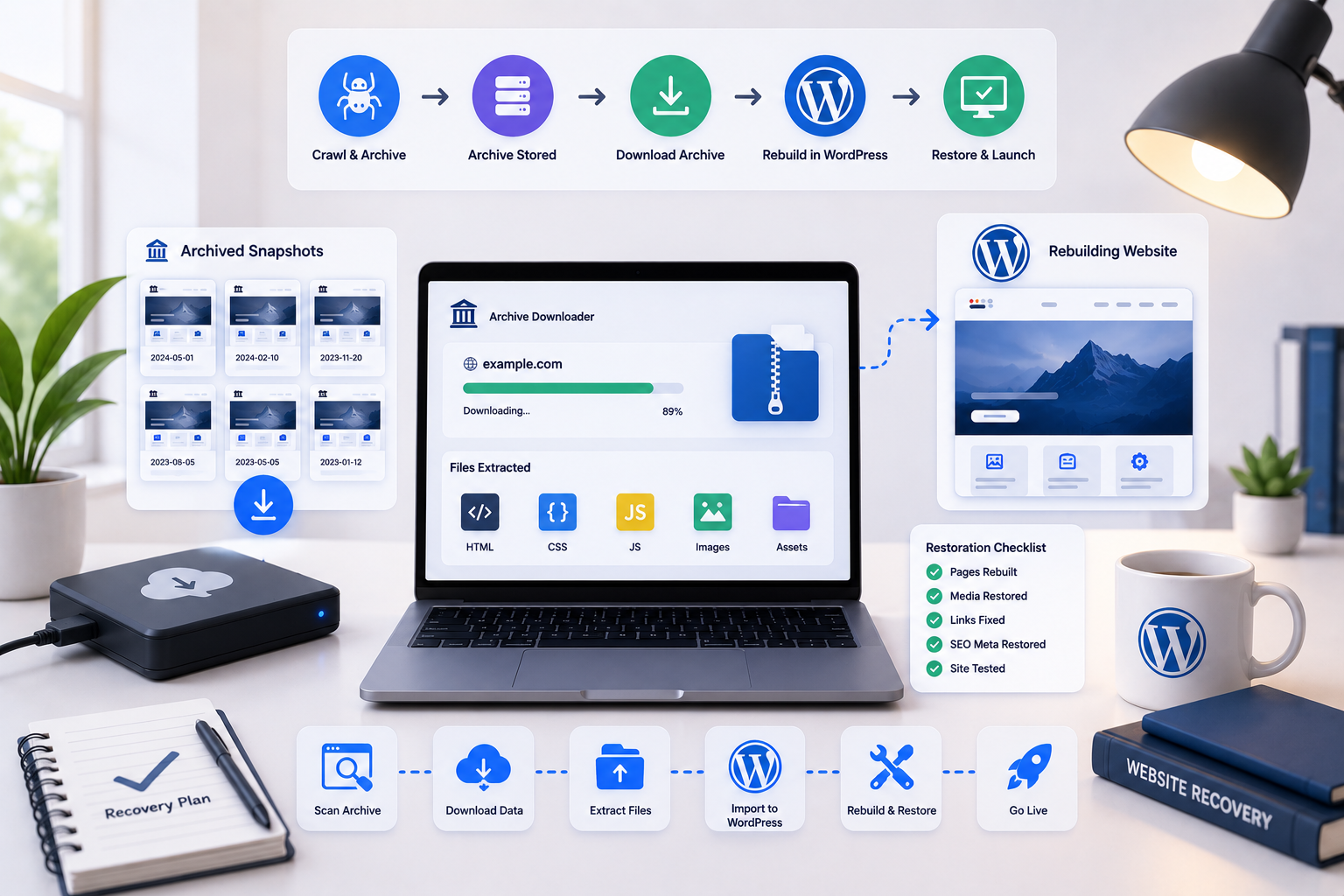
Internet Archive (Wayback Machine)
The Internet Archive is usually the starting point for most website recovery projects.
It allows users to:
- view archived snapshots,
- analyze historical versions,
- and identify recoverable content.
The quality of restoration depends heavily on:
- how frequently the website was archived,
- how complete the snapshots are,
- and whether important assets were captured successfully.
For many deleted websites, the archive becomes the primary recovery source.
Website Downloader and Archive Extraction Tools
Some recovery projects involve downloading archived website data before rebuilding begins.
Archive extraction tools can help collect:
- HTML files,
- images,
- archived pages,
- and website structure data more efficiently.
For example, tools like Wayback Machine Downloader can help simplify the process of extracting archived website content from the Wayback Machine.
These tools are especially useful when:
- multiple pages need recovery,
- large archived websites are involved,
- or structured rebuilding is required.
However, downloaded archives still usually require:
- cleanup,
- rebuilding,
- responsive optimization,
- and SEO corrections.
WordPress Rebuilding Tools
Once archived content is recovered, rebuilding tools help transform the archived website into a modern working website.
Depending on the project, this may involve:
- Elementor,
- Divi Builder,
- custom WordPress themes,
- or manual development.
The rebuilding stage is where:
- structure,
- responsiveness,
- performance,
- and usability
are improved significantly.
SEO and Technical Audit Tools
After restoration, SEO auditing tools help identify:
- broken links,
- missing metadata,
- crawl issues,
- duplicate pages,
- and performance problems.
This is important because restored websites often require:
- cleanup,
- optimization,
- and technical corrections before going live.
How Long Does Website Restoration Usually Take?
Website restoration timelines vary depending on:
- archive quality,
- website size,
- missing assets,
- and rebuilding complexity.
Some small websites can be restored relatively quickly, while larger projects may require significant manual work.
Small Websites
Simple websites with:
- a few pages,
- basic layouts,
- and good archive coverage
can sometimes be restored within a few days.
Examples include:
- portfolio websites,
- local business websites,
- or simple service websites.
If the archive is complete, recovery becomes much faster.
Blog Websites
Blog restoration projects usually take longer because they often contain:
- many articles,
- category structures,
- images,
- and internal linking systems.
The restoration process may include:
- rebuilding blog layouts,
- restoring article formatting,
- optimizing images,
- and fixing archive inconsistencies.
The timeline depends heavily on the number of posts and the archive quality.
Business Websites
Business website restoration often requires additional work because SEO preservation becomes more important.
This may include:
- preserving URL structures,
- rebuilding landing pages,
- restoring service pages,
- and improving responsiveness.
Business websites also usually require:
- cleaner rebuilding,
- testing,
- and more detailed quality control.
eCommerce Websites
eCommerce restoration projects are usually the most complex.
Even if product pages are archived successfully, dynamic systems like:
- carts,
- checkout systems,
- customer accounts,
- and databases
often require rebuilding manually.
These projects usually involve:
- structured redevelopment,
- database recreation,
- and platform rebuilding.
As a result, eCommerce recovery can take significantly longer than standard business websites.
When Should You Hire a Professional Website Restoration Service?
Some archived websites are simple enough for DIY recovery. Others become extremely difficult once the rebuilding process starts.
Professional restoration becomes especially valuable when:
- the website is business-critical,
- SEO matters,
- the archive is incomplete,
- or technical rebuilding becomes too complex.

Complex Website Structures
Large websites with:
- many pages,
- custom layouts,
- dynamic features,
- or advanced functionality
usually require structured rebuilding work.
Professional restoration helps ensure:
- the structure remains organized,
- navigation works properly,
- and the rebuilt website remains maintainable long-term.
SEO-Sensitive Websites
If a website already had:
- rankings,
- backlinks,
- indexed pages,
- or organic traffic,
SEO preservation becomes extremely important during recovery.
Poorly handled rebuilding can damage:
- search visibility,
- page indexing,
- and URL authority.
Professional restoration usually focuses heavily on:
- URL preservation,
- redirects,
- metadata restoration,
- and internal linking structure.
Incomplete Archives
Some archived websites only preserve partial data.
This may require:
- combining multiple snapshots,
- recreating missing layouts,
- rebuilding missing assets,
- or manually restoring structure.
Professional rebuilding becomes important when the archive alone is not enough to recreate a stable website properly.
Business-Critical Website Recovery
For businesses, website restoration is often not just about recovering old pages.
It may directly affect:
- leads,
- customers,
- SEO visibility,
- and brand credibility.
In these situations, a structured professional restoration process helps reduce risk and ensures the rebuilt website is:
- functional,
- responsive,
- optimized,
- and reliable long-term.
At this point, you should now have a much clearer understanding of:
- how professional website restoration works,
- what realistic recovery expectations look like,
- and why rebuilding archived websites usually involves much more than downloading snapshots alone.
Frequently Asked Questions About Website Restoration
Can all websites be restored from the Wayback Machine?
Not always, but many websites can be partially or fully recovered depending on the archive quality.
Recovery success usually depends on:
- how often the website was archived,
- whether important pages were captured,
- and how the original website was built.
Simple websites are generally easier to restore than highly dynamic platforms.
Even when a complete recovery is not possible, archived snapshots often provide enough content and structure to rebuild the website professionally.
Does the Wayback Machine save everything?
No. The Wayback Machine does not capture every part of a website perfectly.
Some elements may be missing, including:
- databases,
- dynamic content,
- videos,
- protected pages,
- or externally hosted assets.
However, many archived websites still preserve:
- pages,
- written content,
- layouts,
- images,
- and navigation structures very well.
This is often enough to rebuild a functional website successfully.
Can images be recovered from archived websites?
Yes, many archived websites still contain recoverable images.
However, image recovery depends on:
- whether the images were archived,
- how the media files were hosted,
- and the quality of the available snapshots.
In some cases:
- all images can be restored,
- some images may be missing,
- or replacement images may need to be recreated manually.
This is one of the most common parts of professional website restoration projects.
Can a WordPress website be restored without backup?
Yes, many WordPress websites can still be rebuilt using archived website data even if no backup exists.
The archived version may still preserve:
- page content,
- layouts,
- images,
- blog posts,
- and URL structures.
However, backend systems such as:
- plugins,
- databases,
- user accounts,
- and custom functionality
usually require rebuilding manually.
This is why WordPress website restoration often involves both:
- archive recovery,
- and structured redevelopment.
Can SEO rankings be preserved during website restoration?
In many cases, yes.
SEO preservation depends heavily on maintaining:
- the original URLs,
- page structure,
- metadata,
- internal linking,
- and content relevance.
If a website is rebuilt carefully, much of its SEO structure can often be preserved successfully.
However, poor restoration practices may cause:
- broken URLs,
- indexing issues,
- and ranking losses.
That is why SEO planning is an important part of professional website restoration.
How long does website restoration usually take?
The timeline depends on:
- the website size,
- archive quality,
- missing assets,
- and rebuilding complexity.
Small websites may take only a few days, while larger business or eCommerce websites can require significantly more time.
Projects involving:
- redesign,
- SEO preservation,
- responsive rebuilding,
- or incomplete archives
usually require additional work.
Can eCommerce websites be restored from archives?
Partially, yes.
Archived versions may still preserve:
- product pages,
- categories,
- descriptions,
- images,
- and layouts.
However, systems such as:
- shopping carts,
- customer accounts,
- payment processing,
- and order databases
usually cannot be recovered directly from archived snapshots.
These systems often need manual redevelopment during the rebuilding process.
Is rebuilding in WordPress better than restoring old code?
In many situations, yes.
Older websites often rely on:
- outdated themes,
- unsupported systems,
- broken code,
- or non-responsive layouts.
Rebuilding the website in WordPress usually provides:
- easier management,
- better responsiveness,
- improved SEO,
- stronger security,
- and long-term flexibility.
This is why many restoration projects involve:
- WordPress rebuilding,
- Elementor rebuilding,
- or modern redesign while preserving archived content.
Final Thoughts on Website Restoration
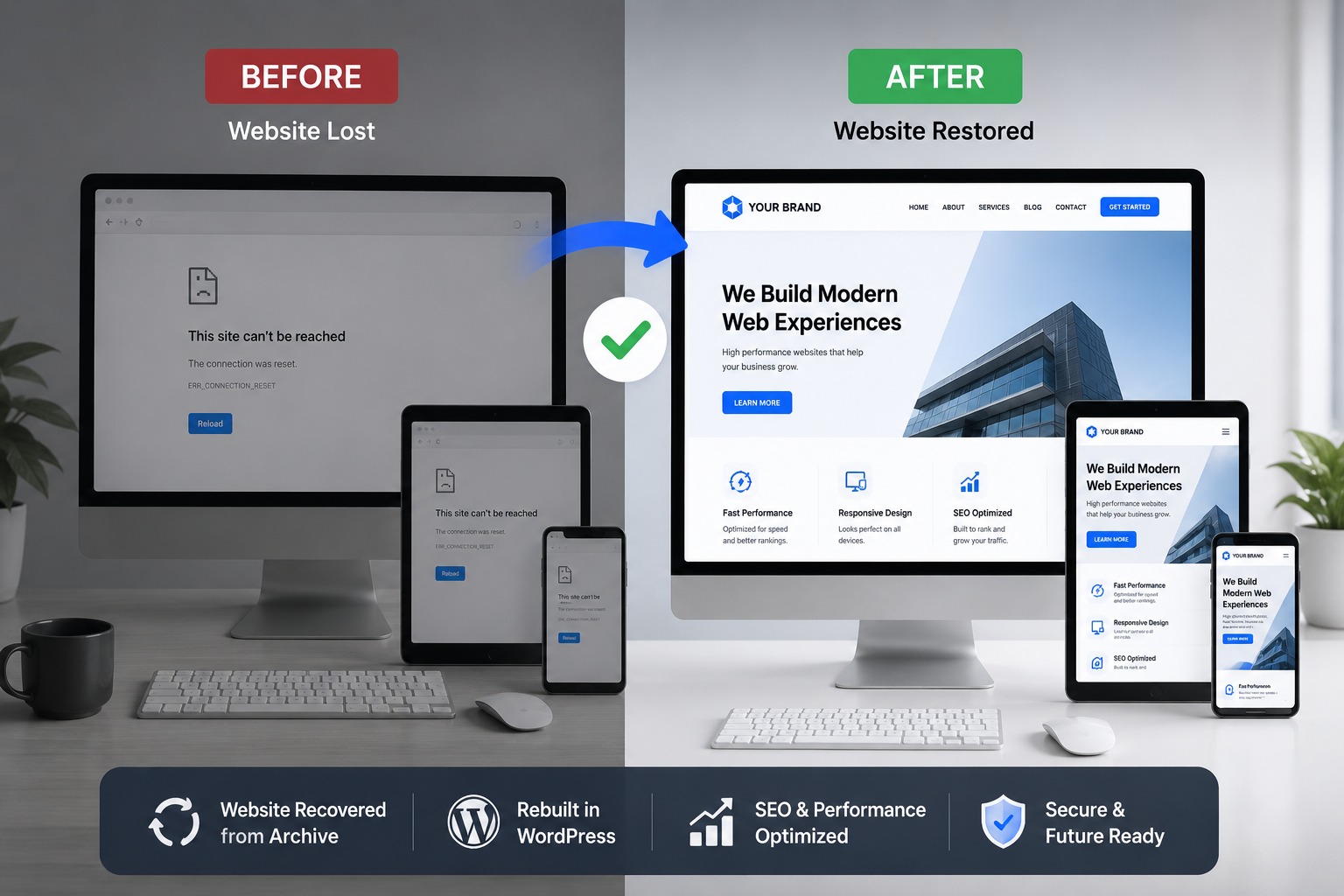
Losing a website does not always mean everything is gone permanently.
Even without backups, archived snapshots can often provide enough information to recover:
- pages,
- blog posts,
- layouts,
- SEO structure,
- and important business content.
However, successful website restoration is usually much more than downloading archived files.
A proper recovery process often includes:
- archive analysis,
- content extraction,
- rebuilding,
- responsive optimization,
- SEO preservation,
- and technical corrections.
The quality of the final result depends heavily on:
- the archive condition,
- the rebuilding process,
- and how carefully the website is restored.
For many businesses, rebuilding the website properly in WordPress becomes an opportunity not only to recover lost content, but also to create a cleaner, faster, and more maintainable version of the website moving forward.
The most important thing is acting early.
The sooner a website recovery project begins, the easier it usually becomes to:
- preserve content,
- maintain structure,
- and reduce long-term SEO damage.
Need Help Restoring a Website from the Wayback Machine?
If your website has been deleted, lost, hacked, or no longer has a backup available, a structured website restoration process may still help recover your content and rebuild the website professionally.
At Wayback Restore, we specialize in:
- WordPress website restoration,
- Elementor rebuilding,
- archived website recovery,
- SEO-focused restoration,
- and rebuilding websites from Wayback Machine snapshots.
Every restoration project is handled based on:
- archive quality,
- website structure,
- business goals,
- and long-term maintainability.
If you want to understand whether your website can still be recovered, submit the old domain through our free archive review. We will assess the available snapshots before recommending a rebuild approach.