To restore multiple websites, assess each authorized domain separately and choose the recovery order by business need, source readiness and dependencies. A shared owner or CMS does not make every site equally recoverable. Start with a per-domain inventory before assigning the whole batch one package or deadline.
The aim is a controlled sequence of accepted sites, not the largest number of downloaded files. The planning method below is a suggested workflow; it does not claim an executed bulk recovery or guaranteed delivery rate.
Give every website its own recovery record
Record the domain, authorized decision-maker, original purpose, required public destinations and available sources. Include relevant custom domains or hostname variants rather than relying only on a portfolio label.
Separate native backups, developer files and public captures. An apparently complete archive for one domain does not establish coverage for a related domain. A shared logo does not establish that the underlying content or media can be reused everywhere.
For each site, identify the intended outcome: a public static site, an agreed CMS rebuild or separately specified operational functionality. Record unresolved rights or authorization questions before reconstruction begins.
Use four triage lanes instead of invented priority scores
Ask the owner which destinations are business-critical and assess whether the sources support meaningful progress. Place each site in a lane:
- Critical and ready: agreed important destinations have usable evidence and a clear delivery scope. Consider these for an early representative pilot.
- Critical but blocked: an important site lacks a required source, permission or specification. Assign the specific unblock action; do not disguise it as ordinary production work.
- Ready but less urgent: suitable for a later compatible batch after the early delivery method is validated.
- Unverified: authority, purpose or source suitability is unclear. Complete the assessment before committing to reconstruction.
This is a decision aid, not a forecast of rankings, revenue or recovery probability. Do not assign numeric success percentages merely because a domain has many captures.
Record dependencies that can change the order
A public page may depend on an approved shared document, brand decision or current product specification. Note that dependency explicitly rather than repeatedly stopping each website at the same point.
Distinguish reusable approved assets from unique site content. Confirm the correct version and permitted use before sharing files between domains. Old sites can have different addresses, offers, audiences or language requirements even when their layouts look similar.
Do not merge websites, change domains or redirect one site into another just to simplify the batch. Those are separate business and URL decisions, not routine recovery shortcuts.
Group tasks without erasing site-specific requirements
Compatible extraction, media checks or page-family reviews may be organized together. Keep source identifiers and destinations attached to the correct domain throughout the work.
Separate a repeated technical check from repeated content. Reusing a verification method is useful; copying descriptions, FAQs or service claims across unrelated sites without review can produce inaccurate or duplicate material.
Maintain a per-domain exception list. A common batch checklist should not hide a missing form, historical path or required document that affects only one site.
Choose a representative pilot, then expand deliberately
The pilot should exercise relevant complexity, not merely the smallest easy homepage. Include a useful page family, media, navigation and the intended owner-editing task. Where the batch contains materially different delivery types, more than one pilot may be necessary.
Google’s site-move guidance recommends separating major changes and, where suitable, testing a smaller section first. That advice concerns migrations with URL changes, not proof that a restoration batch will rank. The practical lesson is to keep each rollout understandable and test its assumptions before scaling.
Preserve agreed URLs wherever feasible. If a domain or path change is separately approved, give it its own mapping and checks. Do not combine a recovery, redesign, CMS change and domain consolidation without a reviewed plan.
Track accepted scope, not just activity
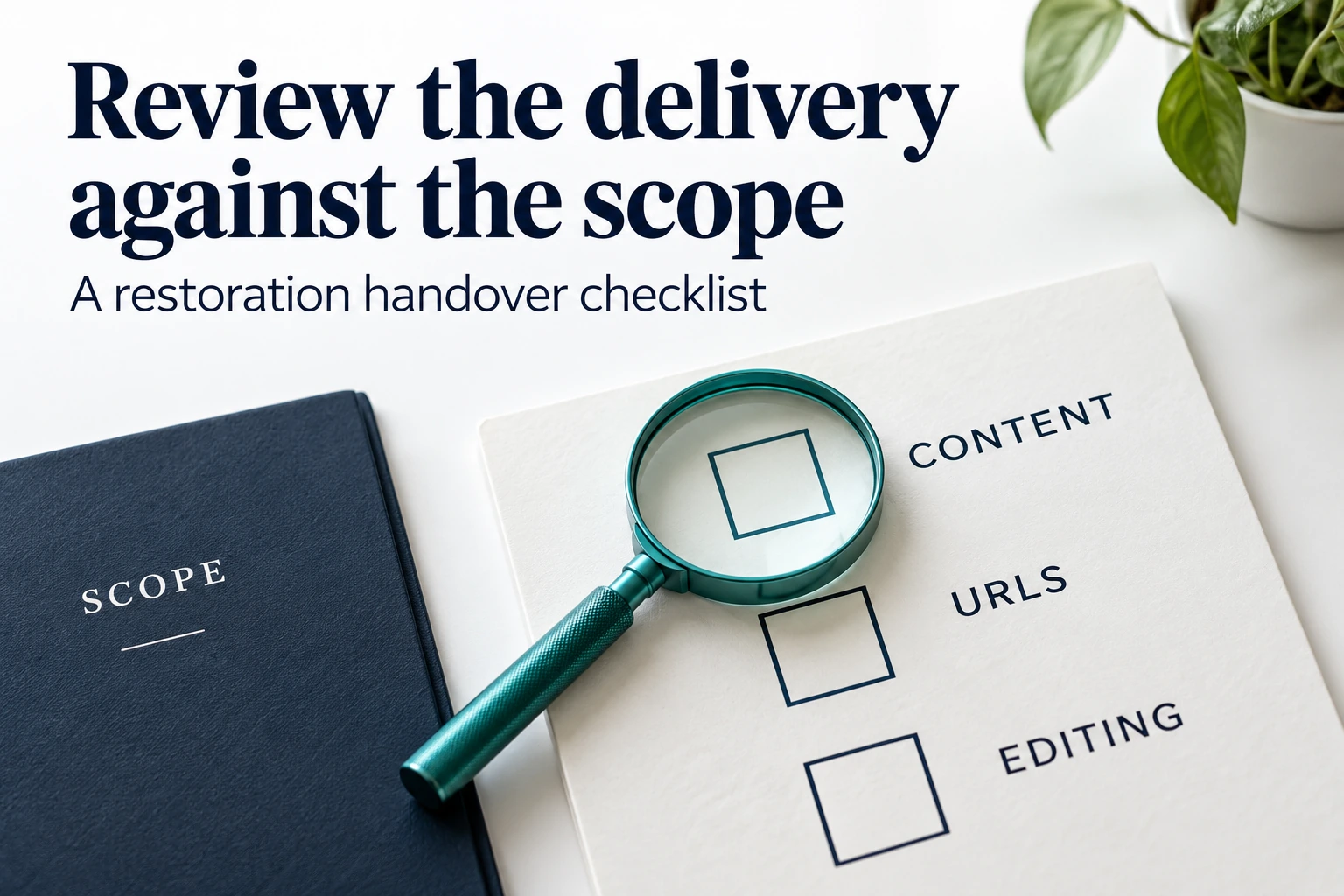
A per-site status should say whether assessment, reconstruction or acceptance is complete and identify the evidence for that status. “Downloaded” does not mean “delivered,” and “delivered” does not establish verified functions.
For each domain, retain accepted destinations, unresolved items, observed QA results and owner decisions. Compare the final record with that site’s approved scope. Never extend a successful test on one domain to every site in the batch.
Keep important blockers visible, including domain access, missing content and required integration tests. Orders, payments and email submissions need their own authorization and verification arrangements.
Send a scope-based bulk enquiry
Provide a domain list, the purpose and urgency of each site, available source dates, the intended output and any essential functions. State which decisions remain open. Do not include passwords in a shared research sheet.
The current restoration service options list bulk work as custom scope. That is not a published universal bulk discount or promise that every domain qualifies for the same fixed package. Assessment should determine the appropriate scope before a quote or timeline is agreed.
For the source-to-delivery process within each site, see the archive restoration guide. Keep batch prioritization separate from the individual site’s technical recovery requirements.
Batch planning questions
Should all domains use one restoration package?
Not automatically. Source coverage, editing needs and included functions can differ between sites.
Can an important blocked site still receive attention first?
Yes, through its unblock action. Do not confuse investigation or a missing approval with a ready reconstruction task.
Are bulk delivery times or discounts guaranteed?
No universal figures are established here. Obtain a scope-specific agreement after the domain-level assessment.